

Imagine yourself marooned on a deserted island. More than twenty-four hours have passed, and not a single sign of life has revealed itself. You wander endlessly, scanning the horizon, listening, hoping for any hint that you are not alone.
Midnight draws near.
Then it happens.
From somewhere deep in the darkness comes a long, eerie howl. Then another. And another. The sound swells, echoing through the night, growing louder, closer. Your breath tightens. Your pulse pounds in your ears as the howling intensifies, wrapping the silence in fear.
And then, suddenly, you wake up and realize it was just a dream.
What would be your reaction in that moment?
The fear vanishes instantly. The body relaxes. Even though the dream felt absolutely real just seconds ago, it no longer has any hold over you.
Now pause here.
What if I told you that the life we are living with such intensity and seriousness is also a dream?
Not metaphorically. Experientially.
This is not a new idea. Advaita Vedanta articulated this truth with remarkable clarity thousands of years ago. The same essence appears across ancient Indian texts, including the Bhagavad Gita. Modern science may still be approaching this understanding from the outside, but inner traditions have explored it from within for millennia.
At first, this sounds impossible to digest. The world feels solid. Emotions feel real. Identity feels personal.
But what happens when you are having a nightmare and suddenly become aware that you are dreaming?
The dream may continue, but it no longer dominates you.
That is exactly what shifts when truth is realized.
Life does not necessarily disappear. Responsibilities may remain. The body-mind continues its role. But the psychological grip loosens. The identities, boundaries, and attachments created by the mind slowly start losing their authority.
This is why detachment is not something a spiritual seeker tries to cultivate deliberately.
It happens.
Spiritual growth and inner attachment move in opposite directions. You may still grow materially, create, earn, relate, and participate fully in life. But inwardly, you are no longer clinging. You are no longer dependent on outcomes for inner stability.
Through regular spiritual practice, or sadhana, one is graced with viveka. The ability to see clearly. To discern what is transient and what is real.
When viveka becomes dominant, vairagya is inevitable.
Not forced. Not practiced. Not performed.
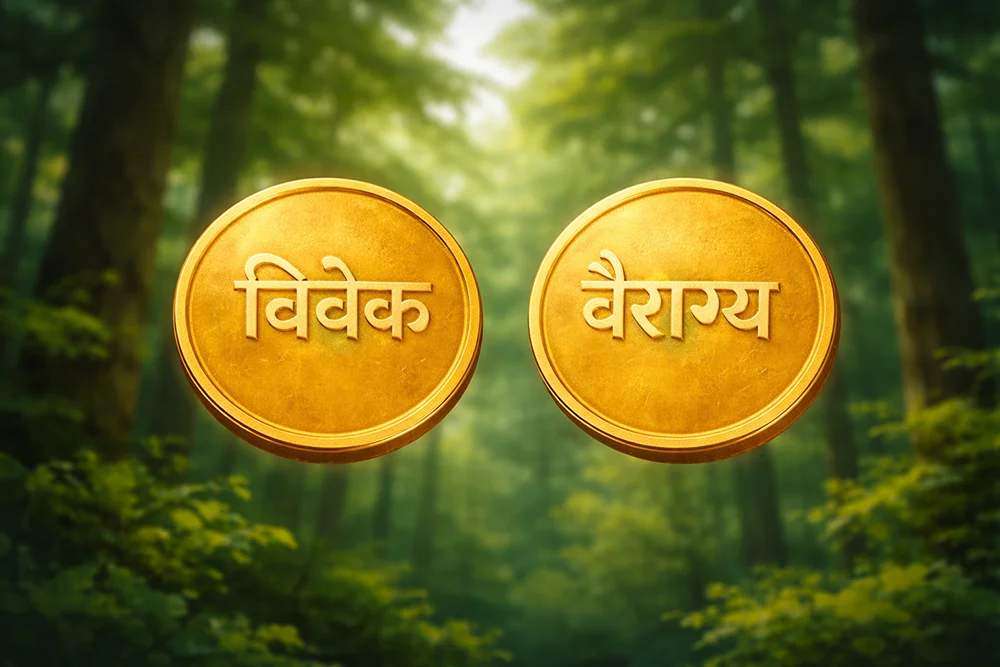
Viveka and vairagya are not separate. They are two sides of the same realization.
दुःखेष्वनुद्विग्नमनाः सुखेषु विगतस्पृहः ।
वीतरागभयक्रोधः स्थितधीर्मुनिरुच्यते ॥One whose mind is not disturbed in sorrow,
who has no craving for pleasure,
who is free from attachment, fear, and anger,
is called a sage of steady wisdom (Sthitaprajna).— Gita 2.56
Just as the nightmare loses its grip the moment you awaken, life too softens when it is seen clearly.
Detachment is not rejection of life.
It is freedom within it.

Leave a Reply